
The Editor as the Second Director: Film Editing Techniques That Shape Every Great Film
In the world of filmmaking, there’s a saying that resonates deeply with anyone who understands post-production: the editor is the second director of a film. While the director captures the vision on set, it’s in the editing room where that vision truly comes to life, where raw footage transforms into compelling narrative, and where the final emotional impact of a film is sculpted.
Why Editors Are Considered the Second Director
The editor’s role extends far beyond simply assembling shots in sequence. They make critical creative decisions that fundamentally shape the story: determining pacing and rhythm, choosing which performances to use, deciding what information to reveal and when, and even restructuring entire scenes or sequences to improve narrative flow. A talented editor can salvage problematic footage, enhance performances, and create meaning that wasn’t explicitly present on set.
This is why many directors form long-term partnerships with their editors. Think of the legendary collaborations in cinema history. These partnerships exist because directors understand that their vision is truly completed in the editing suite.
The Kuleshov Effect: Creating Meaning Through Juxtaposition
One of the most fundamental principles every editor must understand is the Kuleshov Effect, named after Soviet filmmaker Lev Kuleshov. In his famous experiment from the 1910s, Kuleshov intercut the same neutral shot of an actor’s face with different images: a bowl of soup, a girl in a coffin, and a woman on a couch. Audiences praised the actor’s subtle performance, interpreting his expression as hunger, grief, and desire respectively, despite the fact that his expression never changed.
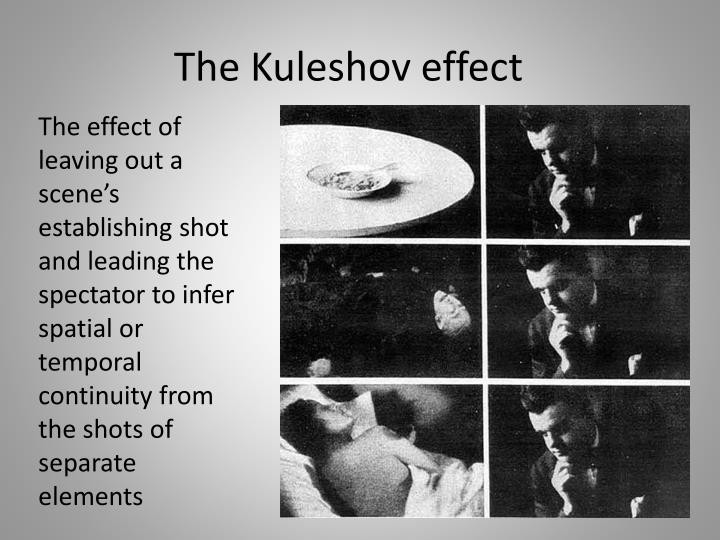
The Kuleshov Effect demonstrates that viewers derive meaning not from isolated shots, but from the relationship between consecutive images. This principle remains the foundation of continuity editing and teaches us that context is everything. As editors, we don’t just cut footage together; we create psychological connections in the viewer’s mind.
Essential Editing Techniques
The J-Cut and L-Cut
These invisible techniques smooth transitions between scenes by separating audio and video cuts. In a J-cut, the audio from the next scene begins before the visual transition, while an L-cut extends the audio from the previous scene over new visuals. These create seamless flow and can dramatically improve pacing.
Match Cuts
Matching visual elements, movements, or compositions across cuts creates visual continuity that can bridge time, space, or even thematic concepts. A character closing their eyes in one location and opening them in another is a simple but powerful match cut.
Cutting on Action
By cutting during movement rather than before or after, editors create fluid transitions that feel natural to viewers. The eye follows motion, and cuts disguised within action become virtually invisible.
The Eyeline Match
When a character looks off-screen, cutting to what they’re seeing creates spatial relationships and directs audience attention. This technique builds the geography of a scene in the viewer’s mind.
Montage and Cross-Cutting
Montage compresses time by showing a series of shots that convey an idea or passage of time, while cross-cutting between parallel action creates tension and shows simultaneous events. Both techniques manipulate temporal relationships to serve the story.
The Power of Silence and Pauses
Sometimes the most powerful edit is the absence of one. Strategic pauses, holding on a reaction, or allowing silence to breathe can create more impact than rapid cutting. Knowing when not to cut is as important as knowing when to cut.
Editing to Rhythm: The Metronome Technique
Some editors approach their craft almost like music composition, using a metronome to establish and maintain rhythmic consistency throughout a sequence. By setting a tempo and cutting to the beat, editors can create an inherent musicality in their work even before music is added. This technique is particularly effective in action sequences, montages, or any scene where you want to build a specific energy level. The metronome becomes an invisible framework that guides pacing decisions, ensuring that cuts feel purposeful and rhythmic rather than arbitrary. Even when not cutting directly on the beat, being aware of underlying rhythm helps editors understand when to accelerate or decelerate the pace of their storytelling.
Tools of the Trade
Today’s editors have access to sophisticated non-linear editing systems that would have seemed like science fiction just decades ago. Professional software options range from industry-standard applications used in Hollywood features to more accessible platforms for independent filmmakers and content creators. Many offer similar core capabilities: multi-track timelines, color correction, audio mixing, and effects integration.
The choice of tool often depends on workflow requirements, budget, and industry standards, but the principles of good editing remain constant regardless of the software. What matters most is not which tool you use, but how deeply you understand the craft of storytelling through the cut.
The Editor’s Mindset
Great editing requires a unique combination of technical skill and artistic sensibility. Editors must be objective advocates for the story, sometimes making painful cuts of beautiful shots that don’t serve the narrative. They must understand pacing and rhythm almost musically, feel the emotional beats of a scene, and maintain continuity while remaining invisible.
The editor sees the film not as it was shot, but as it could be. They find performances in unexpected places, discover connections between scenes that weren’t scripted, and shape the emotional journey of the audience frame by frame.
Conclusion
The editing room is where films are truly made. It’s where the second director takes thousands of individual moments and weaves them into a cohesive, emotionally resonant experience. Whether you’re cutting a feature film, a commercial, a documentary, or social media content, the principles remain the same: every cut must serve the story, every transition must feel motivated, and every frame must earn its place in the final piece.
As you develop your editing skills, remember that technology is just a tool. The real craft lies in understanding human psychology, visual storytelling, and the invisible art of making audiences feel without realizing they’re being guided. That’s the true power of editing, and why editors deserve recognition as the second directors of every film they touch.