
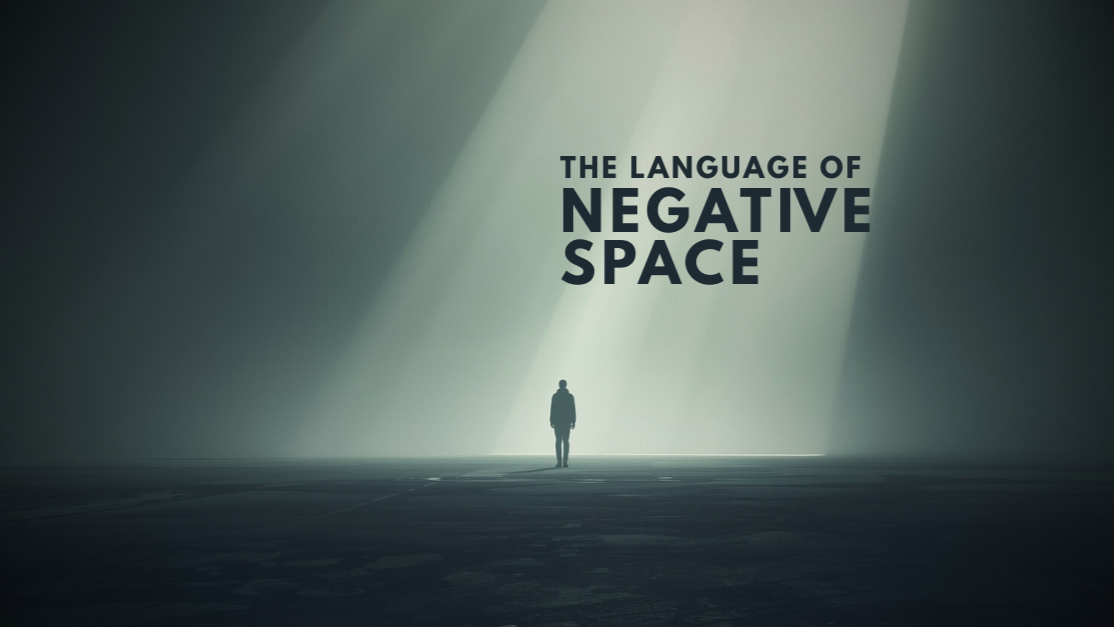
How Silence, Emptiness, and Absence Drive Storytelling in Film and Games
We’re so used to thinking about stories in terms of what fills them, dialogue, action, music, mechanics, that we sometimes forget the power of what isn’t there. Silence. Emptiness. Negative space. These absences aren’t voids; they’re choices. And when used with intention, negative space in film frames, game levels, and narrative structure speaks louder than any explosion or soundtrack ever could.
This is the language of restraint. And it’s one of the most powerful tools available to any storyteller.
Negative Space in Film Frames: The Power of the Pause
In film, negative space is often visual, frames where the subject is small against a vast backdrop, or pauses in dialogue where the weight of what’s not said tells us more than the words ever could. Negative space in film frames is a compositional and emotional decision, one that directors use deliberately to shift how audiences feel.
Think about the quiet moments in Lost in Translation, two people in a city of millions, isolated by the frame around them. Or the long stillness before the shark strikes in Jaws, where the absence of action becomes the action. Those pauses are where the audience leans in. They create anticipation, intimacy, and reflection in a way that constant motion never could.
Negative space in film frames also functions as emotional punctuation. A wide, empty shot after a devastating scene gives the audience permission to feel. A lingering close-up of a character saying nothing communicates more than three lines of exposition. The frame becomes a container for emotion, not just information.
Negative Space in Games: Silence as Mechanic
In games, negative space works a little differently because the player isn’t just watching, they’re inhabiting. Silence and emptiness can shift the entire feel of a level in ways no cutscene can replicate.
Consider how survival horror games strip away music, leaving only your footsteps in the dark. That emptiness makes every sound sharper, every decision heavier. The negative space is not only background, it’s the mechanic. Players fill the silence with their own anxiety, projecting threat into every shadow.
A quiet hallway gives players time to absorb tension, to reflect, to ready themselves. A vast empty field communicates loneliness more effectively than any piece of dialogue could. Without those pauses, everything becomes noise, and noise, sustained long enough, becomes meaningless.
The Rhythm of Experience: Fast, Slow, Loud, Soft
In both film and games, negative space makes the return of sound, action, or interaction more impactful. After a long moment of quiet, a sudden burst of music or an enemy encounter feels amplified, not because it’s louder, but because it’s been earned.
The rhythm of experience, fast, slow, loud, soft, is where emotion truly lives. Think of the explosion scene in Oppenheimer. Its impact is inseparable from the silence that precedes and follows it. Christopher Nolan understood that negative space in film frames and on the soundtrack wasn’t a gap in the story. It was the story’s most important beat.
Pacing is the craft of knowing when to pull back. The best storytellers, in any medium, treat silence and emptiness not as the absence of content, but as content in themselves.
Room to Breathe: Why Audiences Need the Quiet
Negative space gives players and viewers something we don’t often talk about: room to breathe. A pause in a film lets us process a character’s inner world. A quiet corridor in a game gives us time to feel the weight of what just happened, or what’s about to.
These quieter choices are easy to overlook precisely because they don’t announce themselves. They don’t demand attention. Yet they’re often the moments that linger in memory the longest. We might forget every line of dialogue in a scene, but we remember the silence between two characters staring at each other. We might forget how many enemies we fought in a game, but we remember the loneliness of walking through its empty fields.
Negative Space as a Language of Trust
At its core, negative space is a language of trust. It trusts the audience and the player to fill in the gaps, to feel the weight of what isn’t shown, isn’t said, isn’t scored. Less telling, more letting. Letting us project, reflect, and discover meaning in the quiet.
Negative space in film frames signals a director who respects the audience’s intelligence. Empty space in a game level signals a designer who trusts the player’s imagination. Both are acts of creative confidence, and audiences respond to that confidence, even when they can’t name it.
Conclusion: Let the Silence Speak
Silence and emptiness remind us that not every story is about constant motion. Sometimes the most profound emotions arrive in stillness, in what’s withheld, in what the frame chooses not to fill. Both film and games, at their best, know when to step back and let us lean into the void.
Whether you’re composing a shot, designing a level, or writing a scene, ask yourself what the silence is doing. Negative space in film frames and interactive worlds isn’t emptiness. It’s intention. And intention, wielded well, is the foundation of every story worth remembering.
Learn to speak in quiet. It might be the loudest thing you ever do.