
A Century of Cinema’s Slow Decline, and What Might Save It
There is a question that haunts every cinema owner, every distributor, every filmmaker who has watched the post-pandemic box office numbers crawl back from the abyss. Is this a wound, or is it evolution? Are cinemas recovering, or are they slowly becoming cathedrals, magnificent, still visited, but no longer the center of anyone’s week?
The honest answer is that the decline of cinema attendance is not a single event with a single villain. It is a century-long story of human behavior colliding repeatedly with new technology, economic pressure, and finally a pandemic that functioned less as a cause and more as a full stop. To understand it, you have to start long before Netflix, long before YouTube, and long before COVID-19.
Wave After Wave: Radio, Television, and the Home Screen
Every decade of the twentieth century delivered a new challenger to the cinema’s throne. In the 1930s, it was radio, free drama and music piped directly into the home during the Great Depression, when a cinema ticket was an unaffordable luxury for millions. Attendance collapsed drastically, almost overnight. In the 1950s, the challenger was television, and the blow was structural. TV ownership grew rapidly in a single decade. By 2002, the DVD player and the home theatre system had made “going to the movies” feel optional rather than necessary. Then came Netflix streaming in 2007, followed by Disney+, Prime Video, and Hulu, all offering theatrical-quality films at the cost of a monthly subscription. By 2019, even before the pandemic, global ticket sales had already declined to their lowest level in two decades.
The common thread across all these disruptions is not that people stopped loving stories. It is that each new technology offered the same emotional payload, drama, laughter, escape, with less friction and lower cost. Cinema’s response each time was to escalate the spectacle, widescreen formats in the 1950s, surround sound in the 1980s, IMAX and 3D in the 2000s. But escalating spectacle is a race that gets harder to win the more comfortable sofas become.
COVID-19: The Accelerant
The pandemic did not cause cinema’s decline. But it functioned as a catastrophic accelerant, compressing into eighteen months a shift in habits that might otherwise have taken a decade. Global box office revenues fell. Cinemas shuttered. Studios released films directly to streaming. And audiences discovered, or confirmed, that they could wait. The theatrical window, that period of exclusivity that once made seeing a film in a cinema feel like a privilege, collapsed under emergency pressure, and audiences noticed that the experience of waiting had not been as painful as assumed.
Recovery has been real but incomplete. And it was achieved largely through higher ticket prices rather than more people attending. Revenue without footfall is a short-term fix. A cinema that earns the same money from half the audience is a cinema with half the cultural presence.
YouTube, TikTok, and the Rewiring of Attention
There is a fourth force in this story that is rarely discussed with sufficient seriousness, perhaps because it feels too neurological. That force is short-form video and its effect on the human capacity for sustained attention. Research tracking nearly 100,000 people found that individuals who regularly consumed short-form videos on infinite scroll platforms had significantly worse performance across measures of basic cognition, attention, and emotional health. The researchers noted that “repeated exposure to highly stimulating, fast-paced content may lead to habituation, wherein users become desensitized to slower, more cognitively demanding tasks.”
A cinema film asks something demanding of its audience: two hours of uninterrupted focus, linear narrative engagement, a willingness to sit with ambiguity. For a generation raised on fifteen-second videos algorithmically optimized to prevent disengagement, this is not relaxation, it is effort. The irony is profound, YouTube and TikTok are full of people who love cinema, who analyze it in three-hour essays. Cinema culture has never been more visible. But cultural appreciation and box office attendance are not the same thing.
The Pakistani Chapter: Running a Race from Behind
What makes the global decline of cinema particularly difficult for Pakistan is that the industry was already carrying a significant structural deficit before streaming, before COVID, before TikTok ever existed. The reasons for that deficit are well understood and need no elaboration here. What matters is the consequence: every wave of disruption that hit world cinema hit Pakistani cinema harder, because there was less foundation to absorb the blow.
Consider the arithmetic. When Netflix began eroding theatrical habits in the West, Hollywood could absorb the pressure across thousands of screens, decades of audience infrastructure, and the deep cultural weight of the cineplex as a social institution. Pakistan entered the streaming era with fewer than 200 screens serving a population of 240 million. The per-screen pressure of every new disruption is simply of a different order. When COVID closed cinemas globally, a Hollywood studio could weather eighteen months of closure because it had an ecosystem, merchandise, theme parks, streaming libraries, international markets, to lean on. A Pakistani production house had a film and a prayer.
Competition
The competition from streaming platforms has also arrived in a particularly compressed form. Pakistani audiences, long accustomed to watching content across borders, Bollywood, Hollywood, Turkish dramas, Korean series, have taken to global streaming with enthusiasm. Netflix, YouTube, and local platforms like UrduFlix and Tapmad now compete for the same evening hours that a trip to the cinema might once have claimed. For an industry still rebuilding its audience base, fighting for attention against the entire output of global entertainment on a five-inch screen is an asymmetric contest.
The short-form video problem cuts even deeper here than elsewhere. A generation of young Pakistanis has grown up not on Lollywood films, not even on Bollywood films, but on YouTube and TikTok, a diet of content calibrated for seconds, not hours. The cinema habit cannot be inherited if it was never passed down. The social ritual of the Thursday evening film, once a genuine feature of urban Pakistani life, belongs now to memory and nostalgia rather than lived experience.
And yet there are genuine reasons for optimism, and it would be dishonest to write this chapter without acknowledging them. Khuda Kay Liye in 2007 and Bol in 2011 proved that Pakistani audiences would fill cinemas for the right film. Jawani Phir Nahi Ani, Punjab Nahi Jaungi and Janaan proved they would come back again and again when given something that spoke to their world. The revival was fragile, yes, and interrupted, yes, but it was real.
Recognition
And it brings genuine joy to see the government recognize this. When grants and funds are extended to support local film production, as has happened in recent years through various cultural and arts initiatives, it is a signal that the state understands cinema not merely as commerce but as identity. Pakistan has stories worth telling on a large screen. It has directors with vision, writers with voice, and actors with the range to carry them. What the industry needs, more than anything, is the stability and resources to tell those stories without having to fight for survival at every step. Government support, when it comes, is not charity to a struggling business. It is an investment in the country’s image of itself.
What Might Actually Save Cinema
The usual responses to cinema’s decline are tactical: bigger screens, premium formats, better food, reclining seats. These help at the margins but do not address the structural problem, which is that the cinema’s value proposition, a communal experience in a dedicated space, must compete with infinite on-demand content available at near-zero marginal cost.
The theatrical window must be defended, not surrendered. Every time a studio releases a film simultaneously on streaming and in theatres, it teaches the audience that patience is rewarded. The window of exclusive theatrical availability is not an anachronism, it is the mechanism that creates urgency and social synchrony around a film. A film everyone is watching together, this weekend, because it is only available here: that is a cultural event. A film you can watch whenever you want is content.
Reclaiming Identity
Cinema must reclaim its identity as an event, not a format. The most resilient cinemas globally are not the ones offering the same passive experience as a sofa, but with a bigger screen. They are the ones that offer something genuinely unreplaceable: a director in conversation, a film scored live by an orchestra, a midnight screening of a cult classic, a curated season of films from a particular country or era. These experiences cannot be streamed. They exist only if you are there.
Governments and cultural institutions must treat cinema infrastructure as cultural infrastructure. In Pakistan this is especially acute. A country with fewer than 200 screens serving a population of 240 million cannot sustain a film industry. Government policy on taxation, censorship, and the Bollywood ban must stop oscillating with every diplomatic temperature change and instead reflect a long-term commitment to cinema as a public good. The creative freedom that was stripped away in the 80s must be fully restored, not partially, not cautiously, but as a policy principle.
Paradigm Shift
The streaming platforms, paradoxically, may also be part of the solution. For countries like Pakistan, where theatrical infrastructure remains thin, streaming has given filmmakers access to audiences they could never reach theatrically. A Pakistani film on Netflix is seen by the diaspora in the Gulf, in the UK, in North America. That visibility builds cultural capital that can translate, over time, into theatrical ambition. The goal is not to fight streaming but to use it as a launchpad rather than a destination.
Finally, and most fundamentally, the films have to be worth the journey. Cinema’s deepest problem is not distribution or technology or attention spans. It is that too much of what is produced for theatres does not justify the effort of leaving the house. The blockbuster franchise model has narrowed the range of theatrical cinema so dramatically that entire demographics, adults without children, people who want something other than a superhero, find little reason to go. Restoring the middle of the market: the adult drama, the literary adaptation, the bold political film, the kind of story that Shoaib Mansoor has shown Pakistani audiences will show up for, is the only sustainable answer to an audience that keeps asking why it should bother.
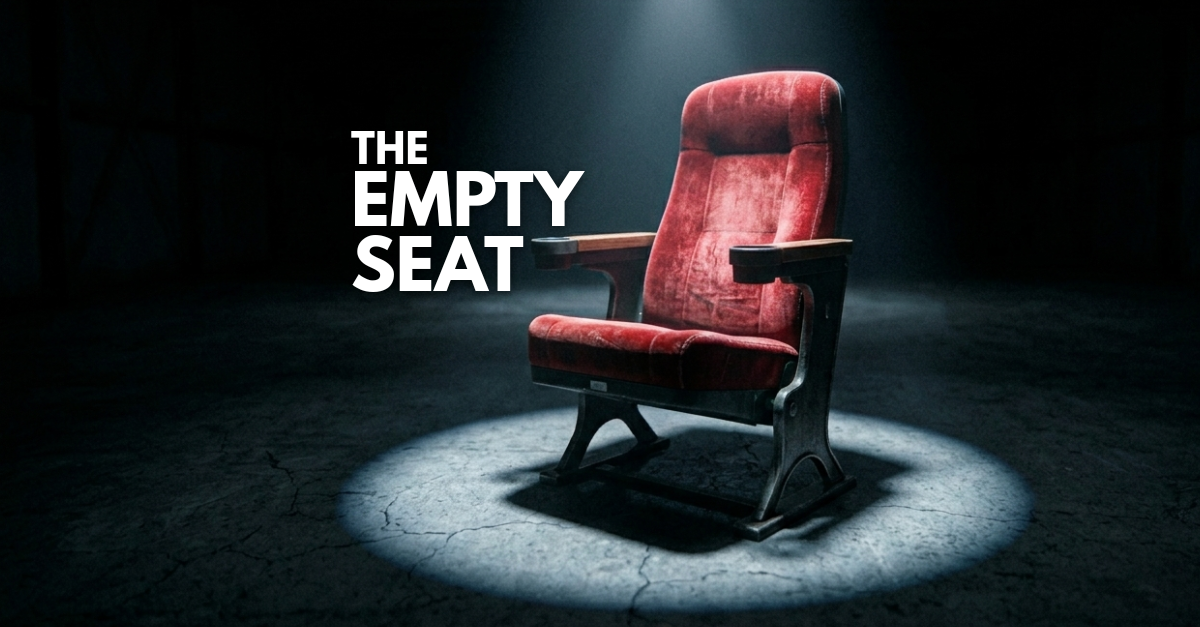
The Seat Is Still There
The seat has been emptying for a hundred years, in waves, for reasons both accidental and designed, economic and neurological, viral and algorithmic, and in Pakistan’s case, political and deliberate. The causes have changed; the direction has not.
But the seat has never been completely empty. And as long as there are films worth the journey, stories told with enough courage, craft, and urgency that the act of watching them together matters, some of us will still make it.
The cinema does not need to beat Netflix. It needs to be something Netflix cannot be.