

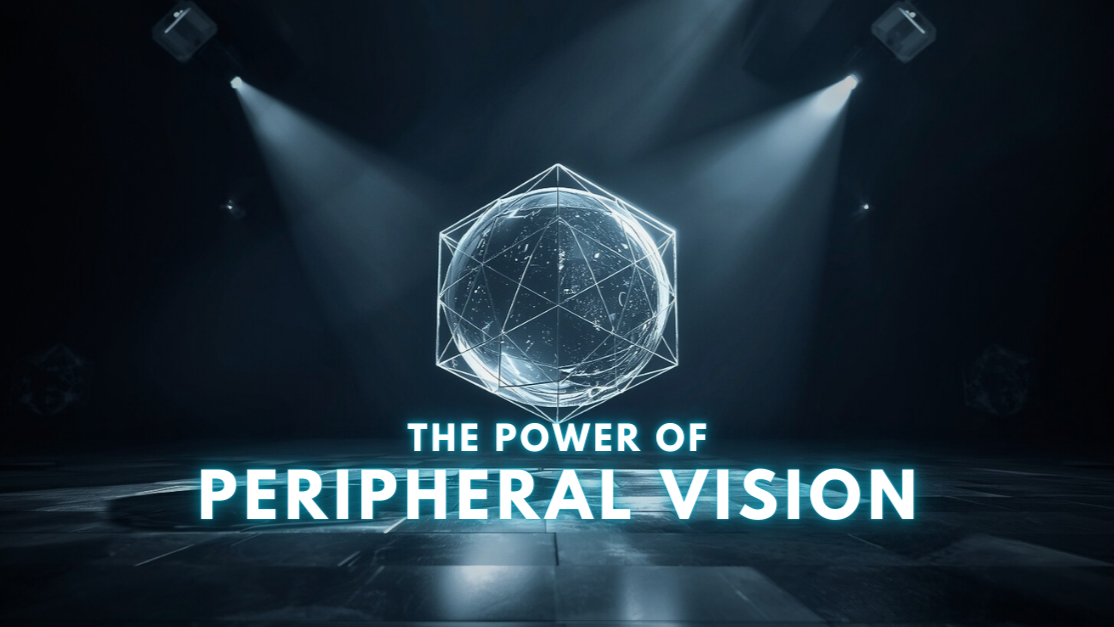
In the pursuit of creating something meaningful, we often fall into the trap of tunnel vision, focusing so intensely on our project that we lose sight of everything else. While dedication is admirable, this narrow focus can paradoxically limit our creative potential and produce work that serves only our own perspective. The solution lies in what I call “peripheral vision” – the ability to maintain emotional distance from our work while staying attuned to the broader context around us.
The Geometry of Creation: Cubes vs. Spheres
Consider your project as a geometric shape. When we become emotionally attached and focus exclusively on our vision, ignoring external input and criticism, we create a cube. It may appear perfect and neat, with clean lines and precise angles, but it only projects in perpendicular directions. This limits its reach and appeal to a narrow audience who happen to align with those specific angles.
In contrast, peripheral vision allows us to shape our work organically, like molding a sphere. A sphere projects itself in all directions – it has no harsh edges, no limitations in how it can be approached or appreciated. It caters to a wider audience because it can be viewed and valued from multiple perspectives.

The Doctor’s Dilemma: Professional Distance as Wisdom
The medical profession offers a powerful parallel to this principle. A doctor treating a patient must maintain professional detachment to make sound clinical decisions. When emotional attachment clouds their judgment, they risk overlooking critical symptoms, avoiding necessary but uncomfortable treatments, or prolonging suffering in the name of being gentle. Sometimes, the most compassionate act requires what appears to be brutality, cutting away infected tissue to save the whole.
Similarly, creators must sometimes be brutal with their own work. This means killing beloved ideas that don’t serve the larger purpose, accepting harsh criticism that reveals blind spots, and being willing to fundamentally restructure something we’ve poured our heart into.
The Paradox of Detachment
This creates an interesting paradox: to do justice to something we care about, we must learn not to care too much. Emotional investment drives us to begin the work, but emotional detachment allows us to complete it well. The challenge lies in finding the balance – maintaining enough passion to fuel the effort while preserving enough objectivity to guide it wisely.
When we’re emotionally enmeshed with our project, criticism feels like personal attack. We defend choices not because they serve the work, but because they represent our identity. This defensive posture closes us off from the very feedback that could transform our cube into a sphere.
Cultivating Peripheral Vision: Practical Strategies
Achieving peripheral vision is easier said than done, but several strategies can help:
Embrace Systematic Criticism: Actively seek out diverse perspectives, especially from people who aren’t naturally aligned with your viewpoint. Create structured opportunities for feedback rather than waiting for it to come naturally.
Practice Ego Separation: Regularly remind yourself that criticism of your work is not criticism of your worth. Develop the mental discipline to evaluate feedback based on its merit, not its emotional impact.
Adopt Multiple Perspectives: Periodically step outside your creator role and view your work as various audience members would – the skeptic, the novice, the expert, the busy professional who has only minutes to engage.
Schedule Detachment Periods: Build regular intervals into your creative process where you deliberately distance yourself from the work. Return to it with fresh eyes, as if encountering it for the first time.
Question Your Assumptions: Continuously challenge the foundational beliefs underlying your project. What seems obvious to you might be completely opaque to others.
The Wider Reach
Products created with peripheral vision don’t just serve a broader audience, they often serve each segment of that audience better. By considering multiple perspectives during creation, we build in features, approaches, and appeals that enhance the experience for everyone, including our original target audience.
The cube may look perfect from its intended angle, but the sphere looks good from every angle. In our interconnected world, where audiences approach our work from countless different directions and contexts, the sphere’s universal accessibility becomes its greatest strength.

Conclusion
Developing peripheral vision requires us to hold two seemingly contradictory truths: we must care enough about our work to do it well, yet care little enough about it to change it radically when necessary. This emotional flexibility, this ability to zoom out and see the bigger picture while remaining committed to excellence, may be one of the most valuable skills a creator can develop.
The next time you find yourself defending every detail of your work, consider whether you’re maintaining necessary standards or simply protecting a square from becoming a sphere. Your audience, and your work itself, may benefit more from your peripheral vision than your tunnel vision.